Industries · Plastic molds
Copper Alloys for Plastic Injection Molds: MoldMAX & Beryllium Copper
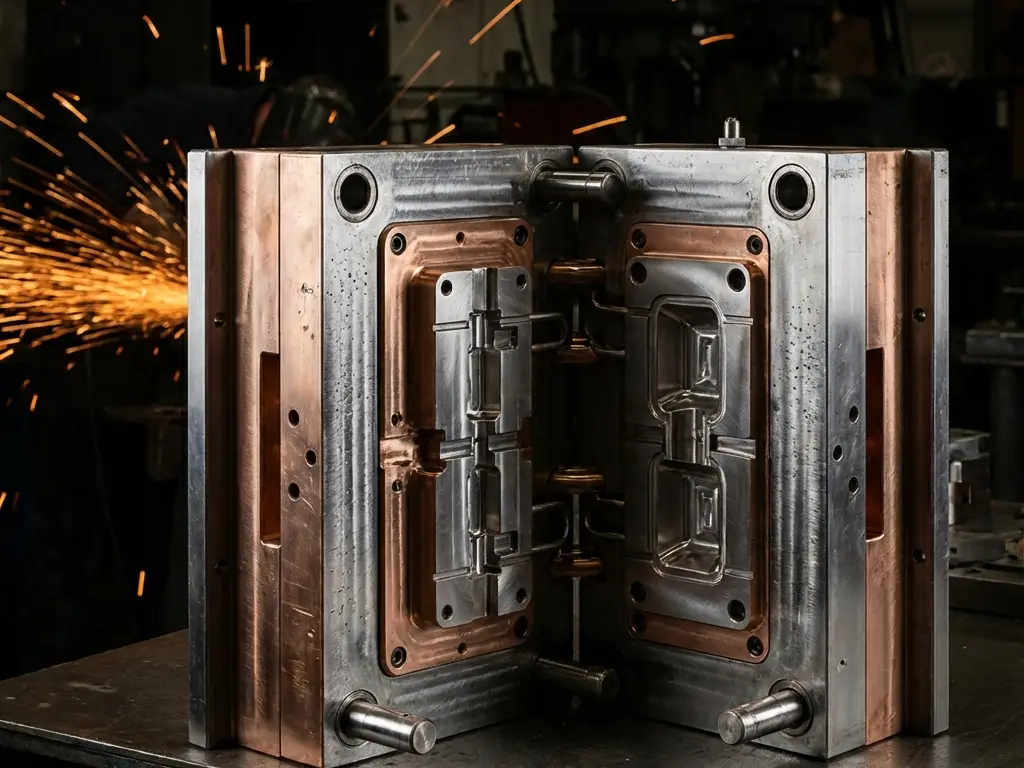
In a plastic injection mold, heat that cannot leave fast enough is what stretches the cycle and warps the part. A copper alloy mold insert pulls heat out of the spots tool steel cannot cool in time. VAN INTERTRADE supplies MoldMAX, Materion's copper mold alloys, including its beryllium copper grades, for injection and blow molds.
Why heat sets the injection cycle
A plastic part can only be ejected once it has cooled enough to hold its shape, so the time spent removing heat from the mold makes up much of the cycle. Tool steel conducts heat fairly slowly. Where cooling channels cannot reach — thin cores, deep ribs, slender pins, the area around the gate — heat builds up into hot spots.
One hot spot makes the whole cycle wait for it, and leaves temperature differences across the part that show up as uneven shrinkage, warping and dimensions that are hard to hold.
Copper alloy inserts and mold cooling
Materion states that MoldMAX alloys offer the strength and wear resistance of tool steels with thermal conductivity up to ten times greater. Used as inserts in steel molds, they cool hot spots and reduce or eliminate the need for cooling channels there.
By minimizing temperature differences across mold parts, Materion adds, MoldMAX gives tighter molded tolerances, less post-mold shrinking or warping, and faster cycles with better part quality. (Materion gives no cycle-time figure; the gain depends on the part and the mold.)
Where MoldMAX inserts are used (per Materion)
- Core and cavity inserts
- Parting-line inserts
- Sliders and lifters
- Hot runner tips
Blow molds
Materion states that MoldMAX alloys improve parting-line maintenance in blow molding and offer longer service life when used for components and inserts in aluminium blow molds.
Materials for plastic molds
- MoldMAX
MoldMAX HH where an insert needs tool-steel hardness and wear resistance, PROtherm where heat removal matters most, MoldMAX V for high conductivity without beryllium, and MoldMAX XL for P-20-class hardness with better conductivity.
Hardness against thermal conductivity, by grade
Typical values from Materion's comparison table, which lists P-20 tool steel at Rockwell hardness 30 and 17 BTU/ft·hr·°F. The table does not state the Rockwell scale.
| Grade | Property | Value | Source |
|---|---|---|---|
| MoldMAX HH | Rockwell hardness | 40 | materion.com |
| Thermal conductivity | 75 BTU/ft·hr·°F | materion.com | |
| MoldMAX V | Rockwell hardness | 28 | materion.com |
| Thermal conductivity | 92 BTU/ft·hr·°F | materion.com | |
| MoldMAX XL | Rockwell hardness | 30 | materion.com |
| Thermal conductivity | 40 BTU/ft·hr·°F | materion.com | |
| PROtherm | Rockwell hardness | 20 | materion.com |
| Thermal conductivity | 145 BTU/ft·hr·°F | materion.com |
Sources: materion.com (moldmax-alloys)
Frequently asked questions
- Why use a copper alloy in a plastic injection mold?
- Because it moves heat much faster than tool steel. Materion states that MoldMAX alloys have the strength and wear resistance of tool steels with thermal conductivity up to ten times greater, so a copper insert cools hot spots, evens out mold temperature and helps shorten the cycle.
- Which MoldMAX grade suits a mold insert?
- It depends on whether hardness or heat removal matters more. In Materion's comparison table MoldMAX HH has a Rockwell hardness of 40 and a thermal conductivity of 75 BTU/ft·hr·°F, PROtherm 20 and 145, MoldMAX V 28 and 92, and MoldMAX XL 30 and 40, against 30 and 17 for P-20 tool steel.
- Does a copper insert remove the need for cooling channels?
- Not always. Materion says MoldMAX inserts in steel molds reduce or eliminate the need for cooling channels at the hot spot. The heat still has to leave the insert, so it is placed where it can pass heat to a cooled part of the mold.
- Can copper alloys be used in blow molds?
- Yes. Materion states that MoldMAX alloys improve parting-line maintenance in blow molding and offer longer service life as components and inserts in aluminium blow molds.
Choosing a material for plastic molds?
Tell us the part, the grade or form you have in mind, the size and the quantity, and we will send a quotation.